


Hello, and welcome back to The Kable. Apologies for not bringing an issue last week but circumstances beyond our control, no really, resulted in an inability to publish. But we have a host of doom, dread, and disease to make up for that this week.
Shall we start with some good news though? We would’ve covered this last week anyway so here goes. The month of December began with The Democratic Republic of the Congo declaring the end of its 16th outbreak of Ebola. And promptly after, the country declared its worst outbreak of cholera this millennium.
The US plan to sign bilateral “health” agreements with African nations one-on-one is proceeding apace. The first such deal was with Kenya, followed promptly by one with Rwanda, and then two more this week with Uganda and Lesotho. We can understand why countries in Africa might feel compelled to sign these partnerships but any gain from these is only short-term. The US, especially under the present dispensation, has only American interests at heart and, as history is our witness, being at the mercy of first world interests is what has brought Africa to this position where short-term gains outweigh long-term interests. A court in Kenya partly agrees, having put part of the Kenya-US deal on hold.
So how about some of that disease we promised you at the beginning of this issue then? The flu epidemic raging through Europe has landed in Iran as well, with deaths going up in capital Tehran by more than 20%. Parts of Spain have imposed a sorta mask mandate - too little, too late in our opinion. In Luxembourg, a triple surge of flu, RSV and Covid (oh yes, Covid) is leaving health systems overwhelmed. In the UK, flu cases have gone up dramatically with several emergency centres beyond critical with patients in record numbers. Also, in the UK, they have now identified a new strain of mpox, that combines clade I and clade II. So much for ignoring Africa’s problems. Scientists in Africa had been warning about something like this for ages.
In the US, vaccine skeptics and vaccine deniers in top government posts have successfully revived measles. The country has definitely lost its measles-free status and now an unnecessary epidemic has left 100s of people quarantined in South Carolina.
People are not the only ones getting affected by disease. In Greece, half a million goats and sheeps were killed by, obviously, goat and sheep pox. So much for feta this year.
Bird flu is still making news too. In South Korea, yet another farm - the 8th this season - reported an outbreak. In the US, 70 vultures were found dead, due to “suspected” bird flu. These vultures were found dead at a school though so can’t rule out a shooting. Another report says at least 9 million birds have so far been exterminated as a consequence of bird flu but, boy, that sounds like such a wild undercount.
If we’re talking disease, let’s talk potential cures too, eh? CEPI has a trio of announcements that should bring hope. Sinergium is launching a trial for an mRNA vaccine for bird flu in Argentina, the University of Oxford is launching a trial for a Nipah virus vaccine in Bangladesh, and in another trial in Ghana, the first volunteer was dosed with a vaccine for Lassa fever.
And finally, coffee. The brew that keeps on giving. A new study says drinking up to four cups of coffee daily slows biological ageing in people with psychiatric disorders. The researchers even said up to four cups is “moderate” consumption. Now, these are researchers one could fall in love with.
Stories Of The Week
Cancer ascendant. Ordinarily, we don’t feature “opinion pieces” here. And we did write about the implications from the Lancet‘s Global Burden of Disease cancer study here. But this bears reading, coming as it does from one of the researchers who worked on that study. Because inspite of 18 million diagnoses, 10 million deaths, and a forecast that nearly doubles both by 2050, cancer still isn’t treated like the global crisis it is, especially in the places carrying two-thirds of the mortality. We even have the science and the evidence, and, dare we say, even the policy playbook to fight this. All we need is the political attention span. If the next 25 years unfold as modelled, cancer won’t just strain hospitals, it will siphon off productivity, destabilise households, and widen global inequities. The crisis is already here. The question is whether anyone will act before the projections stop being projections.
(The Conversation)
Universal Coverage? Still optional apparently. More than half the planet still can’t access basic health services, and about two billion people are pushed into financial pain just trying to stay alive. A new WHO–World Bank report makes it plain: progress flatlined after improving under the Millenium Development Goals between 2000-2015. And then the pandemic that kicked the legs out from under already-fragile systems. Public health spending in low-income countries is now so low that donor aid makes up a staggering 32% of total outlays. At current rates, the global service coverage index limps to 74/100 by 2030 and financial hardship barely moves; nearly one in four people will still be forced to choose between treatment and food. Yes, there are bright spots - country compacts, new pledges from Gavi and the Global Fund, and a push for digitally enabled primary care and regional manufacturing. But none of this masks the basic arithmetic: governments aren’t spending enough, donors can’t keep plugging the hole, and “universal” remains a generous overstatement. The world isn’t failing UHC because solutions don’t exist; it’s failing because the political will does.
(WHO)
Death to mosquitoes. Nature is a wondrous thing and everything created in nature has its place and helps the ecosystem thrive. But mosquitoes, we believe, are the exception that prove the rule. Dengue, West Nile virus, Chikungunya, yellow fever, filariasis, tularemia, dirofilariasis, many varieties of encephalitis, Zika, Rift Valley fever... there is no end to the pestilence this scourge can spread. Especially malaria. As the WHO said this week, after two decades of hard-won gains - 2.3 billion cases and 14 million deaths averted - malaria is inching back up, with 282 million cases and 610,000 deaths in 2024, because the world seems determined to underfund the very fight it claims to care about. Africa still shoulders 94% of cases and 95% of deaths, three-quarters of them in children under five, while five countries alone account for more than half of the global burden. Vaccines (RTS,S and R21), next-gen nets and chemoprevention are delivering real wins but resistance to drugs, insecticides and basic common sense is spreading faster than resources. With malaria financing stuck at $3.9 billion, less than half the WHO target, the “elimination” rhetoric is beginning to sound like wishful multilateral thinking. Until money and political attention show up in the same room, mosquitoes will continue doing what mosquitoes do best. And that’s not buzzing off unfortunately.
(WHO)
Bottom line
If they can’t have water, let them have wine. A new World Bank–CSH analysis shows what many cities already know but rarely quantify: keep spreading outward and you’re effectively pricing hundreds of millions out of clean water and sanitation. Using data from 183 million buildings and 125,000 household surveys across more than 100 cities, the study finds that horizontal expansion could deny 220 million people piped water and 190 million people sewage access by 2050, without a single drought in sight. Sprawling cities already pay the price: water bills run 75% higher, access to piped water drops by half, and outer neighbourhoods have 40% less infrastructure than central ones. Africa is in the crosshairs, with urban populations set to nearly triple and cities already twice as dispersed as those in Asia. The fix isn’t glamorous: build denser, fill gaps, plan like the future matters. But it’s also the cheapest lever governments actually control. Sprawl makes poverty harder, water costlier, and infrastructure dumber. Density isn’t actually a lifestyle choice here. It may be the difference between surviving or not.
(Nature Cities)
Man, it’s those effing mosquitoes again. A new study with over 3,700 health professionals from 151 countries has delivered a blunt warning: the next global health emergency is unlikely to be a cinematic “Patient Zero” moment but a slow-burn disaster driven by mosquitoes, inequality and drug resistance. Malaria and dengue top the list of rapidly escalating threats, fuelled by climate change that’s turning whole continents into five-star breeding resorts for vectors. Tuberculosis and HIV/AIDS follow close behind, with poverty and weakening treatment efficacy worsening the mix. Nearly 90% of respondents were based in low- and middle-income countries - the same places already living the future the North still treats as theoretical. Their message is clear: surging endemic diseases will spill into new geographies, strain economies, and overwhelm health systems long before any novel pathogen knocks on the door. Without climate action and serious investment in infectious-disease tools, the world won’t face a sudden shock. It’ll just drown in a crisis that insists on arriving slowly, then all at once.
(Nature Scientific Reports)
Be the change... or die. Whatever. UNEP’s new Global Environment Outlook reads like a final warning with footnotes: if governments don’t course-correct in the next five years, a child born today will inherit a 2100 that’s 3.9°C hotter, poorer, and choking on pollution. GEO-7 is the most comprehensive environmental assessment ever assembled and its message is painfully simple: the world is barrelling toward a future of collapsing ecosystems, degraded land, surging disease and trillions in economic losses, not because solutions don’t exist but because politics can’t keep up with physics. The report lays out two pathways - behaviour-led or technology-led. But both require whole-of-government coordination, rethinking GDP, phasing out fossil-fuel subsidies - hehe, pricing pollution properly - not coming up with new pollution indices, and redirecting finance at a scale that makes today’s $1.3 trillion climate spend look like pocket change. Upfront costs are steep ($8 trillion a year), but the returns dwarf them: fewer deaths, reduced poverty, and up to $100 trillion a year in economic upside by the late century.
(UNEP)
Young and hot. A new six-country study shows that extreme heat isn’t just stressing crops and power grids - it’s quietly slowing early childhood development, knocking three- and four-year-olds off basic literacy and numeracy milestones long before they step into a classroom. Children exposed to average maximum temperatures above 30°C were up to 6.7% less likely to hit key learning benchmarks, with the steepest drops among those already contending with poverty, scarce water, or crowded urban housing. The dataset is large, the pattern is consistent, and the message is uncomfortable: climate change is reshaping cognitive development at the very start of life. Researchers say we urgently need to understand the mechanisms and design protections that actually reach vulnerable children. Because if heat is already bending the developmental curve in Gambia, Madagascar, Malawi, Palestine, Sierra Leone and Georgia, the world’s future learning crisis may be arriving far earlier, and far hotter, than expected.
(Journal of Child Psychology and Psychiatry)
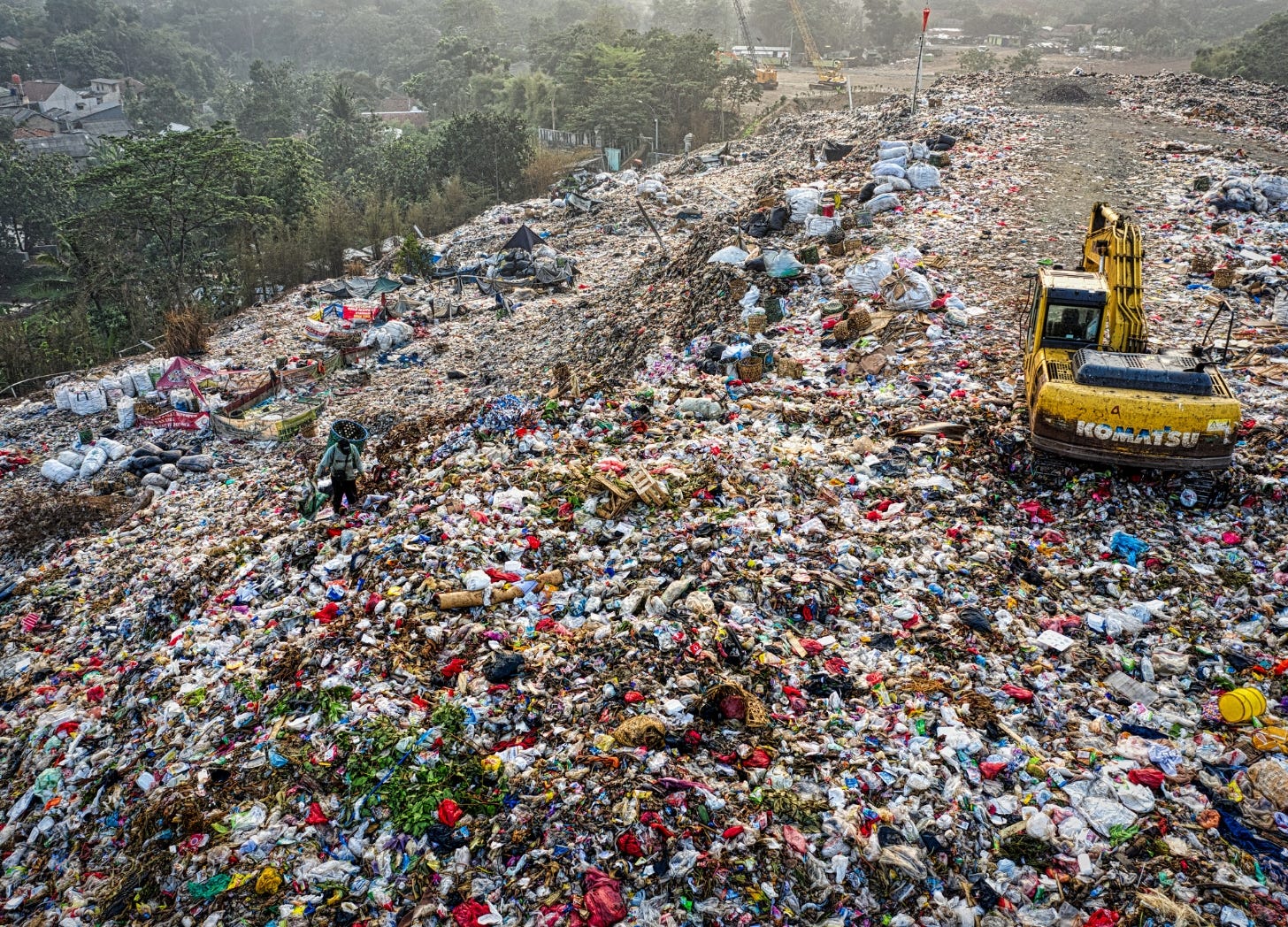
Long live plastic. Plastic pollution is accelerating so fast that by 2040 we’ll be dumping the equivalent of a garbage truck of plastic into the environment every second - up from today’s 143 million tonnes to a projected 309 million, according to a new Pew-backed assessment. Waste systems can’t keep pace, recycling can’t rescue us, and plastic production - driven mostly by single-use packaging - is set to outgrow management capacity by more than 50%, pushing up emissions, health harms and cleanup costs. The bleak part is familiar; the surprising part is that a near-total fix for packaging pollution actually exists. Deposit-return and reuse systems could slash plastic packaging leakage by 97% if governments and companies shift roughly $570 billion a year away from disposable plastics and redesign the most problematic materials out of circulation. Done right, the transition cuts emissions nearly in half and creates jobs. The question isn’t whether the tools work because they do. It’s whether the world will use them before the garbage trucks start lining up by the second. Actually, we know the answer to this one.
(Pew Charitable Trust)
Long reads
Skyscraper. Once again, not a long read but a map. Of what? Of all the buildings in the world. Or almost all. 2.75 billion buildings. Supposedly to help scientists to monitor urban planning, climate change, disaster risks or corruption maybe. But you can have fun, no?
(Global Building Atlas)
Oh, and Gopal Nair doesn’t want you to see this.
👌👌👌👌